

Pathological loss of motivation.
Apathy is a common symptom in many neurological and psychiatric diseases. Better characterization of its origin, in order to facilitate its diagnosis and develop individualized management, would greatly improve the quality of life of patients and their caregivers.
What is apathy?
According to the High Health Authority, apathy is defined clinically by four criteria:
- The patient is suffering from a pathology of which apathy is known to be one of the symptoms;
- Loss or decrease of motivation and/or interest in usual activities and/or emotions for at least 4 weeks;
- This symptom is not caused by taking a drug;
- This change in status leads to an alteration in daily life and social isolation.
However, apathy, although a common symptom, is still poorly defined, under-diagnosed and its therapeutic management is limited.
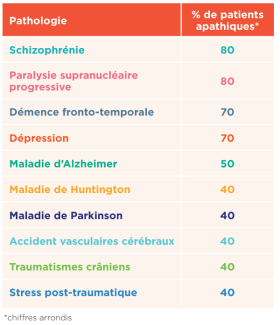
Apathic people often describe an impression of being "at a standstill", of failing to get moving, even for simple tasks. This feeling can lead to a great deal of misunderstanding among people around them, who sometimes attribute these behaviours to a lack of will. Yet the origin is biological: apathy occurs when certain brain networks of motivation are disrupted.
The Brain Causes of Apathy
Apathy is very common in neurology. It can occur in many diseases of the central nervous system. Research at the Brain Institute shows that it is not linked to a single region but to a series of circuits linking:
- The prefrontal cortex, essential for initiative and action planning.
- The deep structures of the brain, such as the basal ganglia, involved in the evaluation of effort and the initiation of movement.
- The limbic system, which manages emotions and how an action gives us or not a sense of reward.
When these networks are altered, even slightly, motivation decreases, behaviours become less spontaneous, and the ability to organize one’s daily routine gradually erodes.
Diseases in which apathy is common
Apathy is observed in a large number of neurological pathologies. It may even be one of its first signs:
- Alzheimer’s disease and neurodegenerative disorders: Apathy is one of the most common behavioural symptoms of Alzheimer’s disease. It results from progressive damage to the frontal regions and limbic system.
- Parkinson’s disease: Beyond motor symptoms, apathy affects a large proportion of patients, sometimes linked to dopaminergic fluctuations.
- Stroke: Depending on the area affected, a stroke can disrupt motivational circuits and lead to long-term apathy.
- Head injuries, brain tumours, multiple sclerosis: In these situations, apathy may develop when the lesions reach the fronto-subcortical networks.
Apathy may also be associated with psychiatric disorders such as depression or schizophrenia, which sometimes complicates diagnosis.
Apathy, fatigue, depression: how can we make a difference?
Because apathy profoundly changes behaviour, it is often confused with other disorders. However, there are several elements that help to distinguish them.
For an apathetic person, the major difficulty is initiative. She does not manage to get involved in an activity, but can find pleasure once the action is started. In depression, it is often the other way around: sadness and loss of interest dominate, even in once-valued activities.
Fatigue is a feeling of physical or mental exhaustion. It does not prevent motivation per se but limits the physical or cognitive capacity to carry out an action.
Understanding these nuances is essential to adapt management and avoid misunderstandings that can be painful for patients and those around them.
How is apathy diagnosed?
The diagnosis is based on a clinical assessment by a physician or neuropsychologist. It generally includes:
An in-depth interview to analyse everyday behaviour, lifestyle and recent changes.
Specific questionnaires to assess motivation, initiative and emotional commitment.
Cognitive tests to measure the functioning of the prefrontal cortex and executive functions.
At Paris Brain Institute, standardized assessment tools and innovative research protocols allow for a better understanding of the different types of apathy and their origins.