

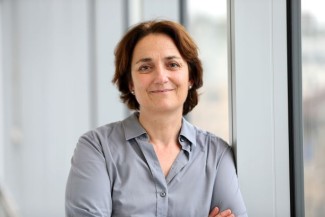
POTIER Marie-Claude
Title: PhD
Function: Team Leader, PI


Biography
Marie-Claude Potier is co-leader of the team on Alzheimer’s Disease and Prion Diseases at Paris Brain Institute and Director of Research at the CNRS. She holds a Ph.D. in Pharmacy (1983) and a Ph.D. in Neuropharmacology from Pierre and Marie Curie University (1988). She is corresponding member of the French National Academy of Medicine, member of the American Society for Neuroscience, the International Society to Advance Alzheimer’s Research and Treatment, past President of the international Trisomy 21 Research society (T21RS). She is also associate editor of CMLS, an external expert reader for several international and national international agencies and foundations. In 2005, she received the Dagnan Bouveret Prize from the Institut de France and in 2024 the Prix Bernadette et Pierre Duban de la Fondation pour la Recherche Médicale.
Research
The team of Marie-Claude Potier and Stéphane Haïk is interested in understanding the causing events leading to protein misfolding in sporadic AD and prion diseases, the role of strains and their cell tropism in specific patterns of propagation of misfolded proteins and develops biomarkers and therapeutic research from preclinical models to clinical applications.
In Alzheimer’s disease and Down syndrome, Marie-Claude Potier showed that membrane cholesterol profoundly alters APP trafficking, Aβ production, and endosomal morphology, findings she also observed in patient cells and linked to synaptojanin-1 (Marquer et al. FASEB J. 2011; Cossec et al. Hum. Mol. Genet. 2012; Marquer et al. Mol. Neurodegener. 2014; Corlier et al. Transl Psychiatry. 2015; Xicota et al. Transl Psychiatry. 2023). She is now investigating APP’s cholesterol-binding site using iPSC-derived neurons and new mouse models and have expanded her work to the locus coeruleus, amyloid pathology in DS and APP-duplication cases, and blood–brain barrier models (Hanbouch et al. Mol. Neurobiol. 2022; Kasri et al. Acta Neuropathol 2024; Fructuoso et al. & Valay & Potier Alzheimers Dement. 2025). Clinically, she identified medium-chain fatty acids predicting brain amyloid in at-risk individuals and she developed refined polygenic risk scores, while more recently extending these approaches to biomarker discovery in psychiatric disorders (Xicota et al. EBioMedicine 2019; Xicota et al. Neurology 2022; Sires et al. Brain Behav Immun. 2025).