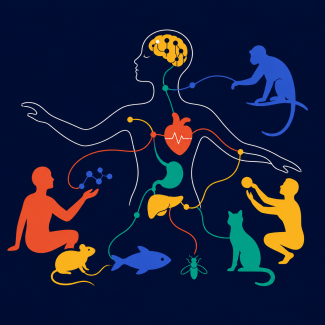
How does the brain communicate with the rest of the body? From molecular messengers to whole‑organ interactions, this 4‑day interdisciplinary event explores the continuous dialogue between the brain and other organ systems across the animal kingdom.
The program brings together neuroscientists, physiologists, computational biologists and clinicians to discuss the multidirectional interactions that regulate homeostasis, emotions and cognition, highlighting how body states shape brain function. Beyond a scientific conference, The Body in Dialogue offers an immersive experience bridging science and art. Submit an abstract to be selected for a talk! Priority will be given to early career researchers. This event will promote early career researchers in integrative approaches that go beyond the traditional brain-centered perspective and to foster collaborations led by early career researchers between research institutes across the world.
THURSDAY DECEMBER 3 – KEYNOTE READING
The conference will open with two keynotes that will set the conceptual framework for the meeting around embodied control, movement and feedback principles in biological systems.
Maha Mahadevan - Harvard University, United States
Noah Cowan - Johns Hopkins University, United States
FRIDAY DECEMBER 4 – INTEROCEPTION
Is interoception a sensory system like the others?
This day will explore how the brain receives, represents and uses information from within the body. Does interoception function like traditional sensory systems such as vision or hearing, or is it based on different principles? Discussion will include cardiorespiratory cues, bowel, breathing and their influence on brain dynamics, perception and behaviour.
Olivier Desmedt - UC Leuven, Belgium
Catherine Tallon-Baudry - LNC2, École Normale Supérieure, Paris, France
Leah Banelis - University of Copenhagen, Denmark
Nicolas Karalis - Institut du Cerveau, Paris, France
Rui B. Chang - Yale University, United States
Veronica Egger - University of Regensburg, Germany
Sophie Bagur - ESPCI, Paris, France
Sarah Garfinkel - Brighton and Sussex Medical School, UK
SATURDAY 5 DECEMBER – CEREBROSPINAL FLUID
Night & Day: How Cerebrospinal Fluid Orchestrates Long-Range Communication Across the Brain & Body
This session will focus on cerebrospinal fluid (CSF) as a long-range communication pathway between brain and body. Interventions will explore its relationship to sleep, vascular activity, motor states and integrated brain-body states.
Lauren Hablitz - University of Rochester, United States
Mickael Tanter - Institut Langevin & QBio, Paris, France
Claire Wyart - Inserm & Institut du Cerveau, Paris, France
Virginia Ruetten - Janelia Research Campus, USA
Laura Lewis - Massachusetts Institute of Technology (MIT), USA
SATURDAY 5 DECEMBER – INTER- AND INTRA-TISSUE COMMUNICATION
Beyond the nervous system: control of physiological set points
How do different tissues and organs communicate to maintain the body’s physiological balance? This session will explore homeostatic loops and interactions between the nervous system and peripheral organs, including adipose tissue, intestine and reproductive organs, and their links to metabolism and cognition.
Ana Domingos - University of Oxford, United Kingdom
Dafni Hadjieconomou - Inserm & Institut du Cerveau, Paris, France
Denis Burdakov - ETH Zürich, Switzerland
Kara Lynn Marshall - Baylor College of Medicine, USA
Michael Krashes - National Institute of Diabetes and Digestive and Kidney Diseases (NIDDK), United States
SUNDAY DECEMBER 6 – METABOLISM
From Molecules to Mind: Metabolism at the Core of Brain-Body Communication
This session will highlight metabolism as a real language of communication between the brain and peripheral organs. Discussions will include metabolites from the liver, gut and microbiota, the regulation of brain energy, and the effects of exercise, inflammation and nutrition on the brain.
Ángeles García-Cazorla - University of Barcelona & Sant Joan de Déu Research Institute, Spain
Fanny Mochel - Sorbonne University & Institut du Cerveau, Paris, France
Juan Pedro Bolaños - University of Salamanca & Institute of Functional Biology and Genomics, Spain
Jorge Ruas - University of Michigan Medical School & Institute for Heart & Brain Health, USA
Karine Clément - Sorbonne University & ICAN, Paris, France
PRACTICAL INFORMATION
Brain Institute Auditorium
Hospital Campus Pitié-Salpêtrière
83 Boulevard de l’Hôpital, 75013 Paris
Metro: Saint-Marcel (line 5) or Chevaleret (line 6)
Type of audience: Scientists
Language preference: English
General information
Dates: 3 to 6 December, 2026
Deadline for registration: 1 November
Registration deadline to benefit from early bird discount: 15/09/2026
Deadline for abstract submission: 6 October
Location: Institut du Cerveau, Campus Hospitalier Pitié‑Salpêtrière, Paris 13
Registration
PBI registration
Trainees wishing to register should send an email to brainbody@icm-institute.org, stating their surname, first name and email address so that we can process their registration. I would also ask you to contact your administrator so that they can take the necessary steps to finalise your registration.
Price : 100 euros
Students, postdocs, external engineers (BSc, MSc, PhD)
Price: 125 euros
Early Bird before 15/09/2026: 100 euros
Standard tarif (IP and others)
Price: 225 euros
Early Bird before 15/09/2026: 180 euros
Organizers
Claire Wyart (ICM)
Dafni Hadjieconomou (ICM)
Sophie Bagur (ESPCI)
Catherine Tallon Baudry (ENS)
Fanny Mochel (ICM)
Contact: brainbody@icm-institute.org