This intensive 3-day course provides a comprehensive introduction to the principles, technologies and applications of Noninvasive Brain Stimulation (NIBS). It is designed for a selected and diverse group of 20 researchers, ranging from Master’s students and PhD candidates to postdoctoral researchers, clinician-scientists and young PIs, bringing together complementary scientific backgrounds, career stages and perspectives in the field of NIBS.
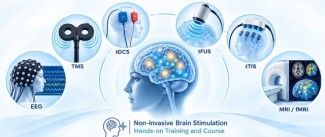
Participants will explore established techniques such as TMS and tES (tDCS, tACS and tRNS), as well as emerging approaches including tTIS and tFUS. The course aims to provide a solid understanding of the physical, physiological and neurobiological principles underlying NIBS, together with their safety, strengths and limitations. Through intensive small-group hands-on interactive sessions, participants will learn to operate NIBS technologies, address practical challenges of stimulation targeting and dosing, and implement reproducible protocols. Students will be familiarised on how to combine NIBS with EEG, MRI/fMRI, PET and robotic neuronavigation to monitor and validate target and network engagement and investigate causal mechanisms of brain function. Finally, the course will provide participants with the methodological foundations needed to design rigorous experimental, preclinical and clinical NIBS studies addressing cognition, brain disorders and rehabilitation, while considering essential ethical and safety requirements. Morning lectures will provide the theoretical foundations, while afternoon small-group sessions will offer intensive hands-on experience with NIBS technologies and equipment. The programme covers fundamental, cognitive, translational and clinical applications, from causal brain mapping and network modulation to rehabilitation in neurological disorders.
Two internationally recognised keynote speakers will enrich the programme: Prof. Inès Violante (King’s College London, UK) will discuss the use of transcranial temporal interference stimulation to study memory, sleep and Alzheimer’s disease, while Prof. Elsa Fouragnan (University of Plymouth, UK) will present applications of transcranial ultrasound stimulation to motivation, reward and decision-making. Participant presentations and open discussions will further encourage scientific exchange, networking and the development of future collaborations. The course aims to provide participants with practical skills and knowledge that they can directly transfer to their own research or clinical programmes, while contributing to the development of a new generation of NIBS scientists and clinician-scientists in France and internationally.
Dates, location and format
The Noninvasive Brain Stimulation Intensive Hands-On Training will take place on 7, 8 and 9 October 2026 at the Paris Brain Institute (ICM), Paris, France.The course is designed for a selected cohort of 20 participants, ranging from Master’s students and PhD candidates to postdoctoral researchers, clinician-scientists and young PIs. All teaching will be conducted in English. The three-day programme combines morning lectures, afternoon hands-on laboratory sessions in small groups, keynote lectures, participant presentations and scientific discussions. The practical sessions will be organised in groups of approximately 10 participants to maximise interaction with instructors and access to the equipment. A course dinner will also provide an opportunity for informal scientific exchange and networking.
Organisers and instructors
Scientific Committee and General Coordination
- Sylvain HARQUEL (SH) PhD, IR CNRS, Laboratoire de Psychologie et NeuroCognition (LPNC), Grenoble; Réseau Thématique CNRS BRAIN STIM NEUROTECH
- Estelle RAFFIN (ER) PhD, CRCN CNRS, Laboratoire de Psychologie et NeuroCognition (LPNC), Grenoble; Réseau Thématique CNRS BRAIN STIM NEUROTECH
- Gregor THUT (GT) PhD, DR CNRS, Centre de Recherche en Cerveau et Cognition (CERCO), Toulouse; Réseau Thématique CNRS BRAIN STIM NEUROTECH
- Antoni VALERO-CABRÉ (AV-C) MD, PhD, DR CNRS, Paris Brain Institute (ICM), Frontlab Team, Paris; Réseau Thématique CNRS BRAIN STIM NEUROTECH
Local Organising Committee
- Lina DAGHSEN (LD) PhD, Course Local Manager, NIBS CENIR PANAM Stim Platform, Paris Brain Institute (ICM),
- Charlotte ROSSO (CR) MD, PhD, PU-PH, Paris Brain Institute (ICM), MOV’IT Team; CENIR PANAM Stim Platform, PaAntoni VALERO-CABRÉ (AV-C) MD, PhD, DR CNRS, Paris Brain Institute (ICM), Frontlab Team, Paris
International Keynote Speakers
- Elsa FOURAGNAN (EF) PhD, University of Plymouth, United Kingdom
- Inès VIOLANTE (IV) PhD, King’s College London, United Kingdom
Instructors and Invited Faculty
- Jean-François AUBRY (J-FA) PhD, CNRS / ESPCI Paris, Paris
- Martina BRACCO (MB) PhD, Paris Brain Institute (ICM), MOV’IT Team, Paris
- Camil BOUSFILHA (CB) MD PhD Candidate, NERV Team, Paris Brain Institute (ICM), Paris
- Guillaume COUDRIET (GC) PhD Candidate, ESPCI Paris / Sonomind, Paris
- Lina DAGHSEN (LD) PhD, NIBS CENIR PANAM Stim Platform, Paris Brain Institute (ICM), Paris
- Cécile GALLEA (CG) PhD, Paris Brain Institute (ICM), Mov’It Team, Paris
- Sylvain HARQUEL (SH) PhD, IR CNRS, Lab de Psychologie et NeuroCognition (LPNC), Grenoble
- Jean-Charles LAMY (JC-L) PhD, Paris Brain Institute (ICM), CENIR PANAM Stim Platform, Paris
- Carlo LETO (CL) PhD Candidate, Paris Brain Institute (ICM), Frontlab Team, Paris
- Pierre POUGET (PP) PhD, CNRS, Paris Brain Institute (ICM), Mov’It Team, Paris
- Lucas POUX (LP) PhD Candidate, Paris Brain Institute (ICM), Frontlab Team, Paris
- Sina VARMAGHAN (SV) PhD, IR CNRS, Lab de Psychologie et NeuroCognition (LPNC), Grenoble
- Fabrizio VICO FALLANI (FVF) PhD, Paris Brain Institute (ICM), NERV Team Paris
Supporting Network
The course is supported by the Collectif ‘Réseau Thématique BRAIN STIM NEUROTECH’, a national scientific network bringing together researchers working on noninvasive brain stimulation and related neurotechnologies.
Registration
Participation is limited to a maximum of 20 participants, selected to foster a diverse and interactive learning environment across scientific disciplines and career stages. Applications will be evaluated on the basis of a short motivation letter describing the applicant’s background, interest in NIBS and how participation in the course would contribute to their current or future research or clinical activities. Particular attention will be given to creating a balanced cohort in terms of career stage, scientific background, methodological interests and geographical/institutional diversity. The course is primarily intended for Master’s students, PhD candidates, postdoctoral researchers, clinician-scientists and young PIs with an interest in NIBS and its applications. Previous practical experience with NIBS is not necessarily required, although a basic background in neuroscience or a related discipline is expected.
A registration fee of €130 will be requested from selected participants. Payment must be made directly to the Paris Brain Institute (ICM) through the dedicated online payment link and must be completed no later than one week before the beginning of the course. Registration will only be considered confirmed once payment has been received.
Further information concerning the application procedure, selection process and payment link will be provided on the course website.
Programme
Day 1: Wednesday October 7th, 2026
8:45: Welcome and program (CR/AV-C)
Lecture 1: 9:00-10:00h General principles for NIBS in fundamental & applied neuroscience (AV-C/GT)
Lecture 2: 10:00-11:00h Conventional & emerging NIBS: A technological perspective (ER/SH)
Coffee Break 1: 11:00-11:30
Keynote 1: 11:30-12:30h Uses of TIS to study Memory, sleep and Alzheimer Disease (Chair: AV-C/CL)
Prof. Inès Violante (IV), King’s, College, UCL, UK
Lunch 1: 12:30-13:00h
Students project presentation & discussion 1: 13:00-14:30 NIBS Methods and Technology (Chairs volunteer ICM PhD students)
Parallel Hands-On / Cross-over sessions (repeated twice for half of the class)
Hands-on lab 1: 14:30-16:00h Motor Threshold, Recruit. curve, Double pulse, Mapping (LD/CR/SH)
Coffee Break 2: 16:00-16:30
Hands-on lab 2: 16:30-18:00 Phosphene Thresholds, Visual and Visuospatial Mapping (AV-C/GT/ER)
Day 2: Thursday October 8th, 2026
Lecture 3: 9:00-10:00h Mapping and modulation of oscillatory activity and network synchrony (GT/MB)
Lecture 4: 10:00-11:00h Uses of MRI/PET neuroimaging to predict or monitor NIBS effects (ER/CG)
Coffee Break 3: 11:00-11:30h
Keynote Talk 2: 11:30-12:30h Uses of tUS for motivation/reward and decision-making research (Chair PP/CR)
Prof. Elsa Fouragnan (EF), University of Plymouth, UK
Lunch 2: 12:30-13h00
Students project presentation & discussion & discussion 2: 13:00-14:30 Causal Functional mapping (Chairs volunteer ICM PhD students)
Parallel Hands-On / Cross-over sessions (repeated twice for half of the class)
Hands-on Lab 3: 14:30-16:00 Hands-on NIBS-EEG, TEPs, phase-reset & entrainment effects (SH/CL/MB)
Coffee Break 4: 16:00-16:30
Hands-on lab 4: 16:30-18:00 MRI-based E-field SimNIBS models: individualisation/optimisation (SV/GC/CB)
Course Group Dinner 20:00-23:00 in a nearby restaurant followed by drinks
Day 3: Friday October 9th, 2026
Lecture 5: 9:00-10:00h Experimental Designs for Causal Cognitive mapping & Network Effects (AV-C/CB/FVF)
Lecture 6: 10:00-11:00h NIBS Risks and Ethics, Regulatory framework & IRB agreements (J-CL (IRB agreement, risks tDCS)/ GT (risks and ethics-TMS)).
Coffee Break 5 11:00-11:30h Lecture 7: 11:30-12:30 To explore & rehabilitate disease: stroke & dementia (CR/AV-C)
Lunch 3: 12:30-13h00
Participant project presentation & discussion 3 : 13:00- 14:30 Pre-clinical/Clinical topics (Chairs volunteer ICM PhD students)
Parallel Hands-On / Cross-over sessions (repeated twice for half of the class)
Hands-on lab 5: 14:30-16:00h tFUS & tTIS operational principles and hands-on demonstration (J-FA/ER)
Coffee Break 6: 16:00-16:30
Hands-on lab 6: 16:30-18:00h Neuronavigated NIBS-EEG cognitive: clinical experiment (SV/CB/MB/AV-C)
Course Farewell session: 18.00-18:30h Final Discussion/Conclusions/Course evaluations