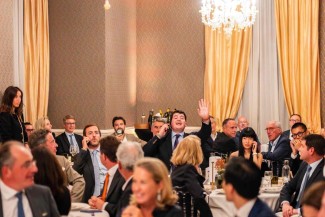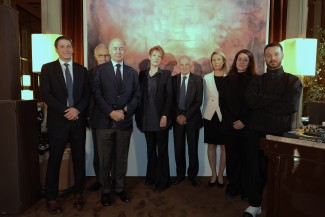
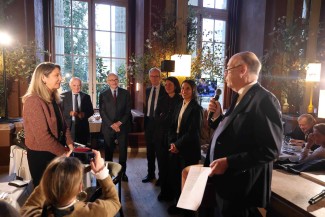
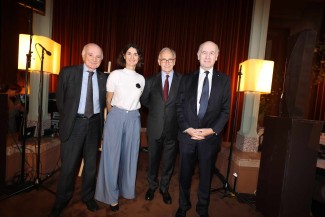
For its 15th edition, the Art-Science Breakfast of the Institut du Cerveau brought together, on October 21, 2026, at the Grand Café of the Grand Palais researchers and researchers, artists and patrons with the transmission as a red thread. By highlighting the perspectives of neurogenetic disease research and unveiling the original artistic creations of artist C.B. Evans based on his dialogue with Prof. Alexandra Durr, the morning highlighted the importance of ongoing and collective mobilization to move research forward. EUR 840 000 was generously pledged by the guests.
Transmission as a scientific and human issue
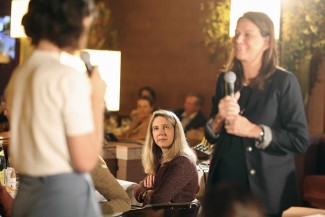
Created in 2011 at the instigation of François Henrot, a major donor and member of the Campaign Committee of the Institut du Cerveau, the Art-Science Breakfast has become over the years an essential meeting point for the Institute’s support community. Hosted this year by journalist and television host Églantine Éméyé, this 15th edition explored what we inherit from our parents, what we pass on to our children and what research can change for families facing neurogenetic disease.
Your gifts are seeds of hope for your children's generation, and perhaps even for yours.
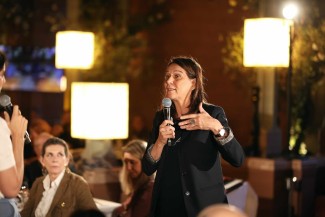
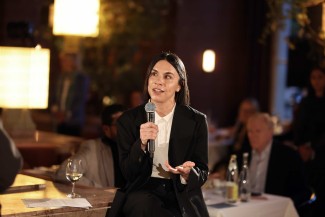
This ambition was at the heart of Dr. Alexandra Durr, a neurogeneticist and team leader at the Brain Institute whose research aims to understand the mechanisms of genetic neurodegenerative diseases in order to develop new therapeutic approaches.
Understanding how the brain resists disease to better prevent it
Why do some people who are born with a genetic abnormality develop symptoms several decades later? This is one of the central questions of Dr. Alexandra Durr’s research. In some hereditary diseases, such as Huntington's disease, a hereditary neurodegenerative disorder that affects about 6,000 people in France and causes motor, cognitive and psychiatric disorders, the first symptoms may appear at the age of 40, 50 or 60. For all the years before, the brain can compensate, at least in part, for the consequences of the genetic defect. Understanding these natural compensatory mechanisms to prolong the asymptomatic phase of the disease and develop preventive medicine is thus a major challenge.
Gene therapy holds promise for people with neurogenetic disease
With her team, Dr. Alexandra Durr is exploring a new strategy against Huntington's disease. While some approaches seek to decrease the production of the protein involved in the disease, his team is studying the possibility of restoring its function. To do this, scientists are working on modified viral vectors capable of delivering therapeutic genetic material to targeted brain cells. This research, which is still experimental, represents a major scientific and technological challenge. They have an essential purpose: to influence the biological mechanisms of disease early enough to delay the onset of symptoms.
When art adds another dimension to research
For Prof. Stéphanie Debette, Executive Director of the Brain Institute, art and science share one engine: creativity, which is essential to explore the unknown and bring new ideas to the surface. This conviction fuels the Institute’s ambition to develop artistic residencies that foster lasting exchanges between artists and researchers.
Dialogue between art and science was also a way of opening up research on society.
This year, the Belgian americano artist C.B. Evans spent several weeks immersed in the neurogenetics teams of the Institut du Cerveau, notably alongside Prof. Alexandra Durr. Accompanied by art historian and exhibition curator Rebecca Lamarche-Vadel, the artist explored a profoundly human question: how to live with the uncertainty inherent in being the carrier of a genetic defect that could cause a disease years later? From this meeting were born two original artistic creations. The first, a musical performance performed by the VIP choir of the Gutenberg School of Saint-Denis, gave voice to future generations through the song You Are Not Alone, by Olive, specially arranged for the occasion by composer and musician Sarah Mokrani. The second, a collage combining scientific images and photographs of the choir's rehearsals, offers a poetic representation of time, transmission and possible futures. These works also highlight an essential dimension of the work of the Institute’s teams: the attention paid to patients, patients and their families, far beyond diagnosis and medical management alone.
Behind each disease, families and generations involved
This reality took on a particularly poignant dimension with the testimony of Geneviève Rogy, whose husband died of Huntington's disease.
"Behind every mutation, every gene, every thing I want to do, there is always a life story," said Dr. Alexandra Durr, a neurogeneticist and team leader at the Brain Institute. The testimony of Geneviève Rogy reminded us how genetic diseases disrupt entire generations and why the development of preventive treatments is a major challenge for our societies. Touched by the cruel reality of communicable diseases, Olivier Goy, ambassador and member of the Campaign Committee of the Institut du Cerveau, who himself has Charcot's disease, also took the floor to appeal to participants to support scientists in order to offer hope to future generations.
Exceptional mobilisation: more than EUR 840 000 for research
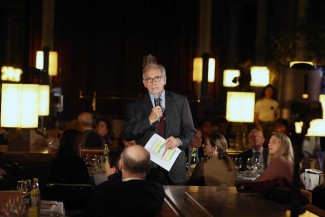
At the end of the event, Serge Weinberg, President of the Brain Institute, praised this mobilization and recalled the decisive role of philanthropy in the Institute's ability to develop new projects and strengthen its scientific and technological capacities. In the face of an ageing population and the increasing burden of neurological and psychiatric diseases, this mobilisation is more essential than ever to speed up discoveries and bring out new therapeutic solutions. The 15th edition of the Art-Science Breakfast thus illustrated the full force of the Institut du Cerveau model: bringing together researchers, doctors, artists, patients and patrons around a common ambition, transforming scientific knowledge into concrete hope for future generations.
The Paris Brain Institute expresses its sincere gratitude to Eglantine Emeyé and to Art Basel Paris for their decisive support for the event.
More about Huntington's disease
Huntington's disease
Huntington’s disease, formerly known as Huntington’s chorea, is a rare and hereditary neurological disorder first identified by the physician George Huntington in 1872. It emerges in adulthood as motor, cognitive and psychiatric disorders that worsen...
Read more