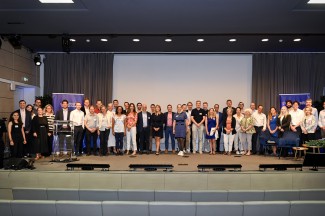
On the 15 September, 2026, Paris Brain Institute hosted the fourth edition of the BrainTech Alliance, an international meet-up bringing together researchers, clinicians, entrepreneurs, investors, and stakeholders from industry, all committed to transforming neuroscience. This was a particularly symbolic edition of the meet-up, as it was the first BrainTech Alliance meeting organized in France. The meeting shed light on the greatest challenges that are shaping the global neuroscience ecosystem today: data collection and their subsequent valorization through artificial intelligence, identification of biomarkers that can be used in clinical practice, and the conditions necessary for bringing new innovations to market.
Data and AI: The New Drivers of Innovation in Neuroscience
The discussions in this 2026 edition focused on a widely shared belief: the future of neuroscience depends on the quality of data and the ability of stakeholders in the field to wield artificial intelligence to use those data responsibly.
In her opening address, Ira Hebold Haraldsen (PhD, MD, AI-Mind Project Coordinator, BrainSymph Chair) reiterated that “Artificial Intelligence accentuates both the value and the weaknesses of our data sets”, and that the central issue is not just one of technology, but also concerns the way in which these data are managed and interpreted.
She believes that neurological disorders should no longer be considered as sudden onset, but rather as evolving processes that are integrated into the biological system as a whole. The databases of tomorrow must reflect this understanding of their complex nature.
This interpretation of affairs resonated with participants during the talks dedicated to the collection and sharing of data. Speakers underlined the need to both strengthen international collaboration, and to make databases reusable between countries and between illnesses, in order to expedite research and neuroscientific innovation, ambitions which also feature on the strategic roadmap currently being deployed by Paris Brain Institute.
The European Model: An Asset for Drawing Investment
Discussions also highlighted an aspect of the European system often considered to be a competitive advantage: an approach to health data founded on trust, scientific quality and integration into healthcare pathways.
Europe has particularly rich research ecosystems, structured clinical cohorts, and a demanding regulatory framework that encourages safe use of data.
Far from being a hindrance, this approach can be a powerful attractive lever for those seeking to invest in robust innovations that are validated clinically and that could generate a real impact for patients.
The exchanges thus showed the potential of a model in which data is not the end goal in itself, but rather a tool seeking to improve prevention, to identify new biomarkers, to tailor treatment, and, eventually, to pre-empt the evolution of neurological disorders.
Beyond its own assets, Europe is also drawing on its ability to build bridges with the most dynamic ecosystems in the world, in particular the United States. The exchanges within the BrainTech Alliance thus underscored just how vital transatlantic co-operation is today in terms of accelerating the development of new technologies. By combining Europe’s scientific excellence, its research infrastructures, and its rigorous approach to health data with American stakeholders’ investing clout and capacity for scalability, this cooperation becomes a major strategic lever. For Europe, this not only attracts international investors, but it’s also an opportunity to reinforce its position as a global leader in brain health innovation.
Building the Next Generation of Innovation Together
The last session of the day was dedicated to the process of bringing an innovation to market. It reminded us that developing performing solutions depends foremost on co-operation.
For Prof. Jean-Cristophe Corvol, Medical Director of Paris Brain Institute, data collection requires joint involvement from patients, doctors, institutions and policymakers. He also put an emphasis on the importance of building trust between the different stakeholders and of finding partners who share the same goals.
The speakers also insisted on the need to develop mobile, easily deployable technologies while maintaining a clear priority: responding to a tangible clinical need before seeking to push through the technology itself.
By choosing Paris Brain Institute for its first French edition, the BrainTech Alliance reaffirmed its desire to harness the strengths of the European ecosystem in order to speed up innovation in neurology and psychiatry. As for Paris Brain Institute, it is delighted to have been able to provide a unique space for dialogue between the research, care, industry, and investment sectors. An important step for strengthening Europe’s place in the brain health revolution and for creating an innovation model founded on cooperation, trust, and the responsible valorization of data for the benefit of patients.
The day was also an opportunity for startup-studio NeuraL to nourish new relationships with key actors in the field, further strengthening our network and our position at the heart of this dynamic innovation. An important step for strengthening Europe’s place.