The European CURE-ND alliance has announced the launch of CURE-ND4ALS, an ambitious, patient-focused initiative that seeks to tackle amyotrophic lateral sclerosis (ALS). The program is supported by the Fonds Invincible Été, a philanthropic fund established by entrepreneur Olivier Goy, who is himself both a sufferer of the disease and an ambassador of the Paris Brain Institute, and by the asociation Les Invincibles. It seeks to remove the main scientific, technological, and clinical barriers that are still slowing down the development of efficient treatments.
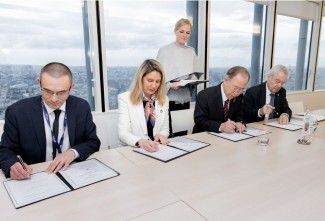
On Friday the 29th of May, the Paris Brain Institute was host to the launch meeting for the Cure-ND4ALS initiative being implemented by the European CURE-ND alliance (Catalyzing a United Response in Europe for Neurodegenerative Diseases). This brought together the Paris Brain Institute, the DZNE (Deutsches Zentrum für Neurodegenerative Erkrankungen), Mission Lucidity (Leuven Brain Institute), and the UK Dementia Research Institute.
Launched by the Paris Brain Institute and spearheaded by its Executive Director, Prof. Stéphanie Debette, this program enables the four partners to take a new step forward by joining forces around a common goal: to accelerate the discovery and clinical translation of new therapeutic approaches for ALS.
ALS, a complex disease that still has no therapeutic solution
Amyotrophic Lateral Sclerosis (ALS), also known as Lou Gerhig’s disease, is a fast-progressing neurodegenerative disease which, over the course of a few years, causes paralysis and then respiratory insufficiency. Despite significant progress in our understanding of genetics and the molecular pathology of ALS, only a very limited number of treatments have been authorized for use, such as Riluzole, which was approved for use in 1995 and which has limited effectiveness, prolonging patients’ lives for two to four months, and Tofersen, an antisense oligonucleotide that was developed recently and is used in patients with the SOD1 gene mutation.
Current challenges include the biological and genetic heterogeneity of the illness, late diagnosis, a lack of biomarker tools facilitating early detection and monitoring of disease progression, limitations of patient stratification, and the low number of patients with ALS taking part in clinical trials.
An integrated strategy for overcoming barriers to research
With Olivier Goy in attendance, the launch meeting was a chance to present and provide details on the strategic pillars of the project, to approve the governance structure, and to establish the steering committee.
The partners plan to have an integrated approach that aligns interdisciplinary resources, methods, and expertise, and that covers the full research continuum, from understanding the illness right up to translational, clinical, and epidemiological research. The stated goal is to bring about large-scale discoveries and to have a strong clinical impact.
The initiative is built on three mutually reinforcing pillars.
- The first pillar seeks to better characterize the diversity of the disease by harmonizing cohorts of very precisely phenotyped patients across Europe. By collating clinical data, cerebral imaging, and genetic and biological analyses, researchers hope to identify new biomarkers and thus to better understand the underlying mechanisms behind the progression of the disease.
- The second pillar involves speeding up the rate of approval of new therapeutic pathways by using humanized cellular models provided by patients. These treatments target in particular the key mechanisms behind ALS, such as the anomalies in the TDP-43 protein, the mutations in the C9orf72 gene, or the neuroinflammatory processes, so as to be able to identify the most promising approaches more quickly.
- The third pillar provides for Europe-wide deployment of the MND-SMRT clinical trial platform. This is an innovative program which makes it possible to test several treatments at the same time using an adaptive framework. This model, the European deployment of which is being coordinated by the Paris Brain Institute, seeks to speed up the clinical analysis of candidate therapies and facilitate patient access to trials.
A key role for the Paris Brain Institute and the French teams
The Paris Brain Institute plays a fundamental role in this initiative, both in scientific coordination and in developing clinical trials in Europe. Its teams are drawing on an incredibly extensive patient cohort, including both symptomatic and presymptomatic patients, as well as on recognized expertise in clinical research, in biomarkers, and in modeling neurological diseases.
At least fourteen researchers and clinicians from the Brain Institute will participate in the CURE-ND4ALS research program.
In order to identify genetic and biological biomarkers and biomarkers detectable with neuroimaging, Dr. Pierre-François Pradat, Dr. Giorgia Querin, and Dr. Isabelle Le Ber, as well as Professor Danielle Seilhean and Professor François Salachas are monitoring a cohort of 1,500 patients who have been categorized according to clinical and biological factors, as well as one of the largest cohorts of presymptomatic patients in the world.
Professor Gaëlle Bruneteau is head of the clinical research structure dedicated to ALS at the Paris Brain Institute and has carried out more than 20 clinical trials over the past five years.
Séverine Boillée and Delphine Bohl, as well as other members of the DecodALS team (Stéphanie Millecamps, Maria del Mar Amador, and Christian Lobsiger) and Morwena Latouche have invested significant resources into developing humanized cellular models that make it possible to study the complex interactions between brain cells in ALS, in particular by using both long-term, co-culture systems derived from iPSC cells and neuroimmune cerebral organoids.
Mathieu Barbier, who works in Isabelle Le Ber’s team, is carrying out research on clinical variability in ALS/FTD cohorts.
Finally, Sophie Tezenas, who works in the ARAMIS team, is designing computational, mathematical, and statistical approaches to multimodal analysis of data from patients with ALS.
A patient-supported initiative that is geared for impact
CURE-ND4ALS receives support from the Fonds Invincible Été, established by Olivier Goy, who is himself a patient with ALS and an ambassador for the Paris Brain Institute. In partnership with the organization Les Invincibles, his incredibly active engagement helps to speed up the implementation of the program and to secure further financing.
Beyond its purely scientific goals, the project has another clear aim, namely to put patients at the heart of research by promoting their participation in studies and integrating their needs into the design of clinical trials.
With a budget of 2.49 million euros over five years, CURE-ND4ALS seeks to build a lasting European infrastructure, capable of speeding up treatment development and transforming ALS research in the long-term. The consortium will receive additional financing from other alliance partners from the first year onwards.
By launching CURE-ND4ALS, the CURE-ND alliance is paving the way for an integrated, fast, and collaborative research ecosystem that will benefit patients and therapeutic innovation.
A brief overview of CURE-ND
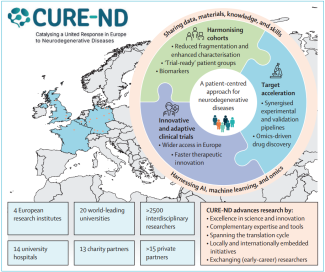
The CURE-ND alliance, established in 2020, brings together four leading national institutes: the Deutsches Zentrum für Neurodegenerative Erkrankungen (DZNE), Mission Lucidity within the Leuven Brain Institute (ML-LBI), the UK Dementia Research Institute (UK DRI), and the Paris Brain Institute (PBI), in order to overcome the urgent challenge posed by neurodegenerative diseases together.
With more than 2,500 researchers and clinician-researchers, the CURE-ND partners have a firm grounding in national academic and hospital research ecosystems. Their finance stream combines structural donations, competitive subsidies, private support, and philanthropic contributions.