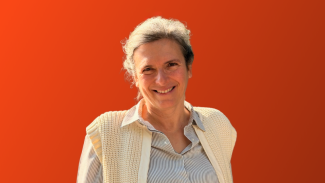
Violetta Zujovic is team leader and scientific manager of the facility. Her research focuses on the immune system’s role in myelin repair, which is a key factor in neurological disorders such as multiple sclerosis and certain leukodystrophies.
With her longstanding commitment to equity and inclusion in research, she has helped shape the future of neuroscience, both within the discipline as a whole and within our institute.
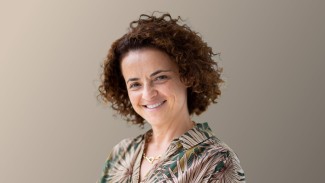
Tell us about your background
I completed my thesis when I was at the company Sanofi-Synthélabo, where I worked on inflammatory genomic targets in neurological diseases. My first post-doctoral training, in Florida, researched chemokine receptor pharmacology. When I returned to France, I continued my research on myelin repair.
Since 2011, I have been a researcher at INSERM. In 2019, I became team leader at Paris Brain Institute. Since 2021, I have been scientific director of the Data Analysis Core biomedical computing facility.
I am also actively committed to equity in research. Since 2015 I have led the Paris Brain Institute equity committee, which is responsible for making equity recommendations. I also chair the ALBA network of neuroscientists from around the world, with the aim of developing equitable and inclusive scientific communities.
What topics does your research focus on?
As a neuroimmunology expert, my work focuses on understanding how immune cells are involved in the repair and regeneration of myelin, the protective sheath around neurons that is essential to their correct functioning.
Since 2011, I have been leading my own research program at INSERM, where I was appointed to a permanent position. My team and I study how immune system cells—whether they are linked to innate or adaptive immunity—influence diseases such as multiple sclerosis or leukodystrophies.
In our research, we combine innovative tools: cutting edge molecular biology techniques, humanized animal models (mimicking human mechanisms as closely as possible) and advanced statistical analyses. But what guides us first and foremost are the patients themselves. Their varying capacity to repair themselves, sometimes against all odds, inspires us: we therefore strive to understand why certain nervous system repair processes function in some patients but not in others. The challenge? Transforming these observations into concrete pathways for more effective and personalized treatments.
How can we combat bias in research and advocate for the inclusion and visibility of women and girls in science?
Neuro-inflammatory diseases such as multiple sclerosis (MS) affect three times as many women as men; an imbalance that raises biological and societal questions.
As scientists, we are committed to routinely integrating sex into our research as a biological variable, to better understand the differences and similarities between the sexes–an essential step in developing more adapted treatments.
Meanwhile, there are still inequalities when it comes to career development among scientists. Unconscious bias and discrimination too often still impede the career progression of women and minorities.
To address these two challenges, we have launched an equity charter at Paris Brain Institute, knowing that neuroscience can shed light on the mechanisms of bias and help us combat them.
I also joined the ALBA network, which has more than 2,000 members in 92 countries, with male and female ambassadors around the world. The aim? To make neuroscience a field where all people—of all genders, backgrounds and identities—are not only represented, but also actively studied and their perspectives incorporated into the research itself.
Now, more than ever, it is crucial that women not only find a place in science, but also redefine it.
For more information
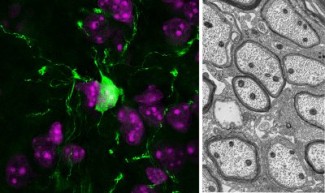
The team aims to understand the neuroinflammatory and metabolic mechanisms involved in multiple sclerosis and leukodystrophies, with a particular focus on the role of cellular metabolism and immune cells in lesion progression and central nervous...
Read more
Multiple Sclerosis (MS)
Multiple sclerosis (MS) is the second leading cause of acquired disability in young adults, after injury. It affects 130,000 people in France today, with 5,000 new cases diagnosed each year. This makes it a major public health issue, since it also...
Read more
Leukodystrophies
Leukodystrophies are a group of around 100 rare genetic diseases involving damage to the white matter of the central nervous system (brain and spinal cord), with or without changes to the myelin of the peripheral nervous system.
Read more