

Attention deficit disorder with or without hyperactivity (ADHD) is part of a wider spectrum of neurodevelopmental disorders (NDD). In other words, disorders associated with an atypical development of the nervous system, and affecting one or more brain functions.
ADHD typically manifests as inattention and/or hyperactivity and impulsivity that do not reflect the typical developmental level.
These symptoms can disrupt people’s day-to-day quality of life, impacting their leisure activities, their professional or school setting, and their social and family relationships.


We use the abbreviation ADHD by convention to refer to attention deficit disorder with and without hyperactivity, rather than ADD, which is less and less used.
Since ADHD carries an increased risk of accidental injury, addiction, depression, and suicide, it is important to identify and manage it to mitigate its impact.
Today, it is now estimated that around 5.9% of children and between 2.5% and 2.8% of adults are affected by this disorder (source: WFA Consensus statement by Faraone et al. 2021).
While signs have a tendency to recede with age in some patients – sometimes with symptoms completely or partially disappearing – we now know that in a significant number of cases, several diagnostic criteria persist into adulthood.
There is currently no scientific evidence to conclude there is an increase in genuine prevalence of ADHD in the population.
The increase in the number of diagnoses we are seeing is, in fact, largely because of an increase in knowledge and awareness around this disorder, as well as better access to care, and better management of neurodevelopmental disorders in general, and of ADHD in particular.
ADHD causes and heredity
ADHD is a multifactorial disorder associated with genetic and environmental risk factors.
Although ADHD has a strong hereditary component, there are very few cases of inherited monogenic forms (i.e. carried by a single gene) of this disorder.
However, there are often cases of family clustering. These are cases in which several people with ADHD or ADD are diagnosed in the same family.
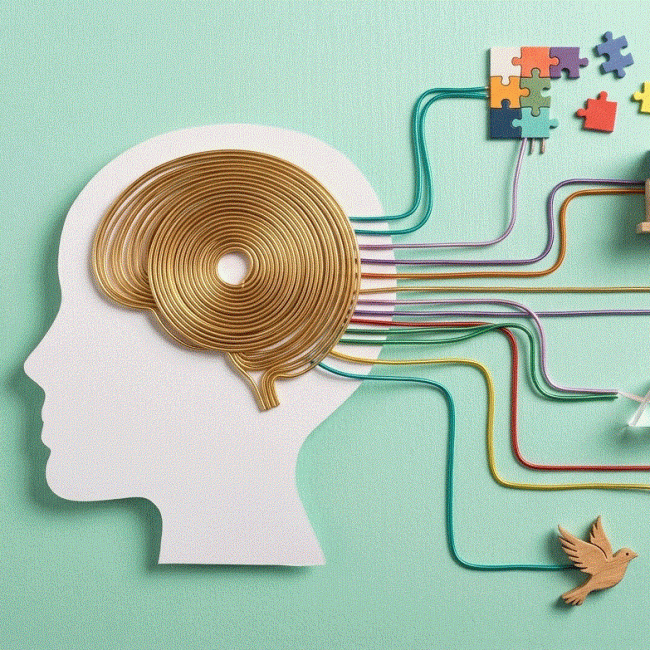
The causes of ADHD are not yet known with certainty, but it has been established that ADHD is not caused by inadequate parenting, psychological stress, insufficient schooling, or a lack of willingness to learn.
More informationLe diagnostic du TDAH
ADHD diagnosis is a differential and clinical diagnosis during which the differences and similarities in symptoms between different diseases or disorders are compared, to establish the most likely and appropriate diagnosis.
Since many other disorders can have symptoms similar to that of ADHD (such as depressive episodes, anxiety disorders, bipolar disorder, and learning disorders), it is important to correctly identify the disorder(s) responsible for the signs observed.
Un bilan neuropsychologique permet-il de diagnostiquer un TDAH ?
A neuropsychological assessment (NPA) does not, as such, enable a diagnosis of ADHD because almost 50% of people with ADHD who take a neuropsychological assessment will show no anomalies. In addition, other disorders frequently associated with ADHD (comorbidities) can distort the neuropsychological assessment.
The neuropsychological assessment can, however, be used during or after diagnosis to specify the cognitive mechanisms of certain difficulties experienced by the patient.
ADHD signs and symptoms
There are two categories of symptoms that point to a diagnosis of ADHD:
- Inattention
- Hyperactivity and/or impulsivity
To make a diagnosis, these symptoms must be present from childhood and have a clinically significant impact. In other words, they must create difficulties in several areas of life: professional, emotional, school, or family.
At present, there is no scale, no score, no test, no brain imaging, and no biological marker that can be used to definitively diagnose attention-deficit disorder with or without hyperactivity.
More informationCare of patients with ADHD
Management of this disorder is multidisciplinary and differs in children and adults.
Management of ADHD in children
In children, psychological and educational accommodations for the patient and the people around them is favored over medication-based treatment, which is only envisaged as a second-line treatment.
Management of ADHD in adults
In adults, treatment with prolonged-release methylphenidate (Ritalin) is usually prescribed as a first-line treatment.
The management of attention-deficit disorder, with or without hyperactivity, is multidisciplinary for both adults and children.
More information
The team led by Liane SCHMIDT & Philippe FOSSATI aims to understand how cognitive control mechanisms integrate external and internal cues and how this integration affects the behaviour of healthy subjects and patients with disorders such as...
Read more
The team aims to discover why we sleep and dream and understand the mechanisms of neurological sleep disorders to treat them better. Both clinical and basic research axes investigate hybrid states between wake and sleep, using neurophysiological...
Read moreThis fact sheet was produced in collaboration with Dr. David Aziz Alaoui, a psychiatry resident and doctoral student at the Paris Brain Institute.
Support the Paris Brain Institute
Did you enjoy this content, and did it help answer your questions? Please consider supporting the Paris Brain Institute.