
Attention-deficit/hyperactivity disorder (ADHD) remains poorly understood from a biological perspective. An international study led by scientists from the Paris Brain Institute and Monash University in Australia suggests that some symptoms may be explained by the intrusion of slow brain waves—usually associated with sleep—during wakefulness. These slow waves could represent a potential biomarker of ADHD and inform new therapeutic strategies by targeting sleep quality and regulation of vigilance.
This press release was originally issued by Inserm.
Frequent forgetfulness, careless mistakes, or difficulty sustaining attention and resisting distractions: attention-deficit/hyperactivity disorder (ADHD) affects about 2.5% of adults, yet its biological mechanisms remain poorly understood.
In a study published in TheJournal of Neuroscience, an international team suggests that the symptoms of this disorder may be linked to the intrusion of slow waves—usually observed during sleep—into wakefulness.
This phenomenon, known as “local sleep,” could explain the fluctuations in attention and the drowsiness often observed in people with ADHD.
To reach these conclusions, researchers compared the brain activity of 32 adults with ADHD who were receiving medication with that of 31 neurotypical adults, while participants performed a task requiring sustained attention.
The result: “Adults with ADHD show a significantly higher density of slow waves, which are usually observed during deep sleep. These waves are not trivial: the higher their density, the more participants make inattentive errors and show slower or more variable reaction times,” explains Thomas Andrillon (Inserm), researcher in the DreamTeam at the Paris Brain Institute and senior author of the study.
Participants with ADHD also reported more episodes of “mind wandering” and “mind blanking,” two states directly correlated with these local sleep intrusions. In addition, the level of fatigue reported by participants increased as slow-wave activity accumulated during sustained attentional effort.
“The intrusion of sleep waves is a perfectly normal phenomenon. Think of a long-distance run: after a while, physical fatigue forces you to take a break. The same applies to mental fatigue. After a day spent awake or following a poor night’s sleep, the brain also takes breaks in the form of slow waves. These brief moments of reduced brain activity occur in everyone. In people with ADHD, however, this activity is more frequent,” adds Thomas Andrillon. “Our results suggest that it could be a key brain mechanism explaining their difficulties in maintaining stable attention and performance over time.”
For the scientists, these slow waves could therefore represent a potential explanatory link between an ADHD diagnosis and the behavioral symptoms observed in everyday life. The findings indeed suggest that ADHD may be, at least in part, a disorder of wakefulness and vigilance regulation.
“These local sleep waves could become a key biomarker for diagnosis”, says Thomas Andrillon.
The results could also guide the development of new therapeutic strategies, both pharmacological and non-pharmacological, particularly interventions aimed at improving sleep quality or stabilizing vigilance mechanisms.
In neurotypical individuals, some research has shown that auditory stimulation during sleep can strengthen nocturnal slow waves, which may reduce the occurrence of sleep-like brain activity during wakefulness the following day. A next step will be to determine whether this approach could also reduce these local sleep intrusions in people with ADHD.
Sources
Pinggal, E., et al. Sleep-like slow waves during wakefulness mediate attention and vigilance difficulties in adult attention-deficit/hyperactivity disorder. Journal of Neuroscience, March 2026. DOI: 10.1523/JNEUROSCI.1694-25.2025.
Funding
This work was funded by the Australian National Health and Medical Research Council (NHMRC) and the European Research Council (ERC).
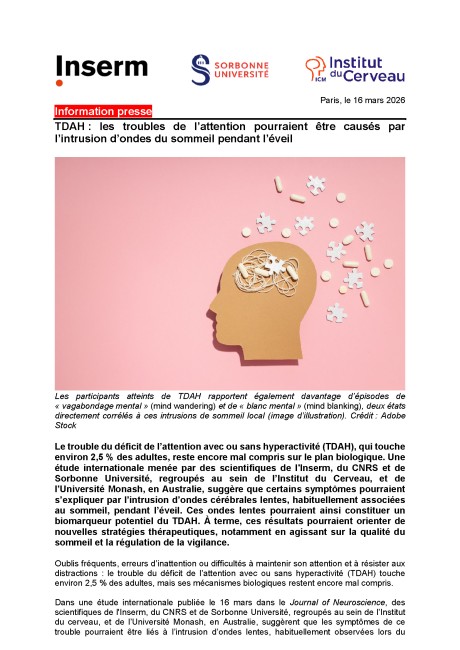
Image
Credit: Sergey Nivens, Adobe Stock.
 ADHD: Attention difficulties are linked to the intrusion of sleep waves during wakefulness
Find the INSERM press release

The team aims to discover why we sleep and dream and understand the mechanisms of neurological sleep disorders to treat them better. Both clinical and basic research axes investigate hybrid states between wake and sleep, using neurophysiological...
Read more