
We tend to take for granted that the thoughts associated with sleep have a particular quality: we often describe them as elusive, abstract, or marked by a certain strangeness. Yet a study conducted by researchers from the DreamTeam at the Paris Brain Institute shows that this assumption is more nuanced than it appears. Our mental experiences—including dream-like ones—do not respect the conventional boundaries between wakefulness and sleep. These findings, published in Cell Reports, challenge the way we picture our mental life.
By convention, wakefulness and sleep are regarded as physiologically distinct states. It is therefore tempting to assume that the images, sensations, and ideas that cross our minds while we are awake are fundamentally different in nature from those we experience while we sleep, and especially while we dream.
“Yet this is far from obvious. Being awake is not synonymous with being attentive, fully aware of one's surroundings, or able to act and think rationally,” explains Delphine Oudiette (Inserm), co-leader of the DreamTeam. “We now know that there is a continuum between wakefulness and sleep, with intermediate states such as mind-wandering or mind-blanking, during which certain regions of the brain may be asleep. What remained to be determined was whether the content of our thoughts also varies independently of our state of vigilance.”
To answer this question, the researchers chose to study sleep onset, the transitional stage between wakefulness and sleep.
“Sleep onset allows us to capture, within a very short time span, fluctuations in our state of vigilance, from wakefulness to sleep, and to observe the mental experiences associated with them,” says Nicolas Decat, a PhD student at the Paris Brain Institute and first author of the study. “As we drift toward sleep, sensations, visions, and snippets of speech unfold—what are commonly called hypnagogic experiences. Tracing the evolution from ordinary thought to dream-like narrative can help us understand how a dream emerges.”
Nap experts to the rescue
To explore the transition between wakefulness and sleep, the team conducted a study with 92 participants who were accustomed to napping and trained to report the content of their thoughts upon interruption.
The researchers used an experimental setup inspired by Thomas Edison. According to legend, the inventor had a habit of falling asleep in his armchair while holding a heavy object, the fall of which would wake him at the threshold of sleep; he would then make use of the whirlwind of creative ideas that flooded his mind during this critical moment.
After each interruption of their nap—either by dropping a bottle held in the hand or by an alarm—participants were asked to describe their mental experience of the previous ten seconds, then rate it on four dimensions: bizarreness, fluidity, spontaneity, and perceived level of wakefulness. In parallel, their brain activity was continuously recorded with an EEG cap.
The researchers then let the data speak for themselves, applying a clustering algorithm that imposed no preconceived categories.
“This data-driven approach was essential for us, because in research, there is no consensus on what hypnagogic experiences actually are. It was important not to bias this exploration with our own definitions or beliefs,” says Nicolas Decat.
A brain signature of dream-like states
The analysis revealed not the two mental states one might expect—dreaming and waking thought—but four. The first (C1) was characterized by fleeting recollections (“An image of my dad crossed my mind”); the second (C2), by a high level of connection to the surrounding environment (“I was listening to the street sounds”); the third (C3), by its bizarreness (“I saw images of small aliens”); and the last (C4), by a high level of voluntary control (“I was thinking about what I would do tomorrow”).
Each of these four mental states appeared across all three vigilance stages measured: wakefulness, sleep onset, and light sleep.
“This is the major finding of our study. The mental states traditionally associated with dreaming can arise just as well when we are asleep as when we are awake. In other words, the content of our thoughts does not follow the boundaries between waking and sleep! One of our participants, while awake, reported seeing ants crawling on her body against a backdrop of crossword puzzles. Conversely, another participant mentally went through his schedule for the next day while he was fully asleep,” adds the researcher.
The team then went further, searching for neurophysiological markers specific to each mental state. By analyzing the complexity of the EEG signal, its spectral power, and the functional connectivity between brain regions, the researchers identified distinctive signatures.
They show that there is a specific brain signature for the “bizarre” C3 mental content—that is, the dream-like state. It is characterized by reduced long-range connectivity between the frontal and occipital regions of the brain.
“This signature may well be the correlate of what we feel in such a state: lucid reasoning is overtaken by a whirlwind of vivid sensations characteristic of dreams,” suggests Nicolas Decat.
Mental activity and introspection
If dreaming is not specific to sleep, why do we have the impression that extravagant mental content occurs only in the depths of the night, when we are oblivious to the world around us?
This preconception probably stems from a memory bias. We mainly remember dreams that come with strong emotions or those to which we attach particular meaning. Yet it is just as common to dream that we are working! Conversely, some people report that fanciful daytime thoughts-elusive, like fragments of a dream-sometimes surface during their everyday activities. Because these thoughts are seen as incongruous, they may well be more frequent than we imagine, but we tend to dismiss them.
Potential applications for sleep disorders
We are generally not very good at judging our own level of vigilance or describing the content of our thoughts. As a result, some people suffering from insomnia regularly complain of spending entire nights without sleeping, even though polysomnographic measurements taken in sleep clinics indicate otherwise.
This is what we call paradoxical insomnia: a mismatch between the patient's experience and clinical observations based on conventional sleep-stage criteria.
“These criteria are probably inadequate. Our study proposes a new one—mental content— which may be better aligned with what these patients actually experience. Through this lens, some of them may spend an unusually long time in an alert state (C2), hyperconnected to the outside world, or, conversely, very little time in a dream-like state (C3), blurring the line between their waking and sleeping lives,” explains Delphine Oudiette. “Beyond giving patients' reports the weight they deserve, this approach paves the way to identifying objective markers of insomnia.”
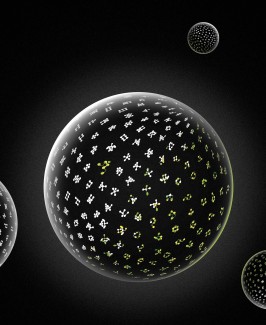
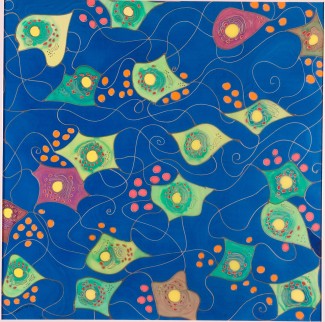
Artistic representation of the gradual transition from wakefulness (white) to sleep (green). Each element represents a mental state: the white shapes reflect typical waking experiences, while the yellow-green shapes become increasingly irregular and strange, illustrating the dream-like quality of mental experiences during sleep onset.
Sources
Decat, N., et al. Dream-like mental states can occur during wakefulness. Cell Reports. Avril 2026. DOI : 10.1016/j.celrep.2026.117237.
Funding
This study was funded by the Bettencourt Schueller Foundation, the French National Research Agency (ANR), the Foundation for Medical Research (FRM), and the European Research Council’s Horizon 2000 program.
Image
Credit: Jorm Sangsorn.


The team aims to discover why we sleep and dream and understand the mechanisms of neurological sleep disorders to treat them better. Both clinical and basic research axes investigate hybrid states between wake and sleep, using neurophysiological...
Read more