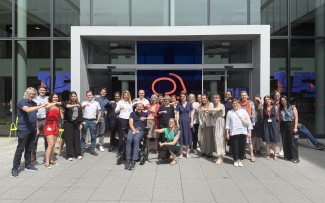
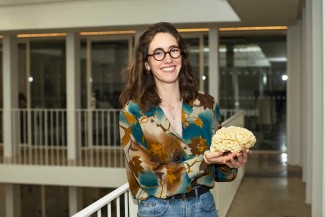
Maëlys Solal, a postdoctoral researcher in the Aramis team led by Ninon Burgos and Olivier Colliot, has received the 20th L’Oréal-UNESCO For Women in Science France Young Talents Award. The award recognises the excellence of her research at the intersection of artificial intelligence, brain imaging and neurology, as well as her commitment to improving the representation of women in science.
Established in 1998, the L’Oréal-UNESCO For Women in Science France Award is part of the L’Oréal-UNESCO For Women in Science programme, which takes an intergenerational approach to helping bridge the gender gap in science.
This year, 35 awards were presented from among 823 applications representing 73 nationalities.
Putting artificial intelligence at the service of medicine
After studying mathematics and computer science at École Polytechnique, Maëlys Solal specialised in artificial intelligence at Oxford, before specialising in cognitive science at École Normale Supérieure. She then joined the Paris Brain Institute (Sorbonne University), where she completed a PhD in computational neuroscience, which she has recently defended. She is now beginning a postdoctoral fellowship in the same team.
Her research focuses on developing artificial intelligence methods for analysing brain imaging. She develops tools to help physicians detect abnormalities in brain images, such as a brain tumour or early signs of Alzheimer’s disease. These tools can also contribute to a better understanding of neurological diseases on a large scale by analysing large volumes of data.
In the short term, the challenge is methodological: improving the robustness and reliability of models so that abnormalities can be detected more accurately, while meeting the requirements of the medical field.
In the longer term, the challenge will be to integrate these tools into everyday clinical practice in order to enable earlier diagnosis, improve patient care, make this expertise accessible to less specialised healthcare centres, and thereby reduce inequalities in access to care, regardless of where patients are treated, whether in hospital or in other regions.
Inspiring future generations of scientists
In addition to her research, Maëlys Solal is involved in teaching and science outreach activities, particularly with high school students. She hopes to encourage more young women to pursue careers in science.
For her, greater representation of women can help improve the quality of scientific research itself by bringing a wider range of perspectives, ideas and research topics.
This recognition from the L’Oréal-UNESCO For Women in Science programme celebrates a career built on interdisciplinarity, innovation and a commitment to putting advances in artificial intelligence at the service of patients.
The entire Paris Brain Institute community warmly congratulates Maëlys Solal on this achievement.
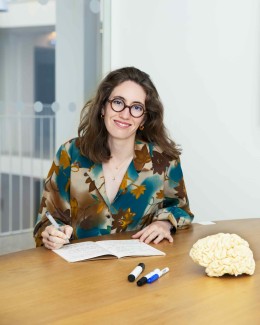
What does receiving this award mean to you?
Receiving this award is recognition of my work as a researcher, but also of my commitment beyond the laboratory, particularly through my science outreach activities.
I also see it as a great opportunity to inspire other young women to pursue careers in science. I have been fortunate to meet inspiring female scientists who gave me the desire and confidence to pursue this path. I hope that, in my own way, I can pass on the same conviction to other young women: they have every right to take their place in the scientific community.
On a personal level, I also hope that this programme will help me gain confidence. Like many women in science, I sometimes encounter certain mental barriers. This award is a tremendous encouragement to continue taking risks and to fully embrace my place as a scientist.
Have you encountered or witnessed difficulties as a woman during your career?
The under-representation of women in computer science and the stereotypes surrounding the field held me back during my career. For a long time, it was difficult for me to find role models I could identify with and envision myself becoming, which contributed to some of the mental barriers I experienced and to a form of self-censorship. I then discovered inspiring communities and organisations for women in science, which finally helped me feel that I belonged and have supported and inspired me ever since.
There is still progress to be made in this area. It is essential to continue to give greater visibility to women scientists, so that other young girls can identify with them and envision themselves pursuing these careers from an early age.
Greater representation would also contribute to better science: diversity enriches approaches and ideas, and it would help place women’s health at the heart of research. Some populations are still significantly under-represented in medical studies, with direct consequences for the care they receive.aîne des conséquences directes sur leur prise en charge.
More informations
The ARAMIS team, led by Ninon BURGOS & Olivier COLLIOT, aims to build numerical models of brain diseases, particularly neurodegenerative pathologies, from multimodal patient databases. The main approaches used are machine learning (artificial...
Read more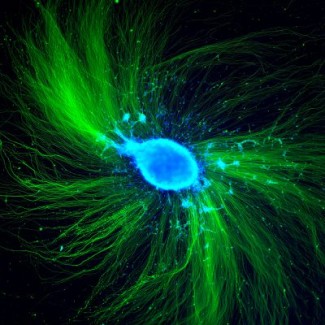
Alzheimer's disease
With longer life expectancies and the biological mechanisms at the origin of neurodegenerative diseases becoming increasingly complex, it is now estimated that, in France in 2020, 1.3 million people were affected by Alzheimer’s disease. Today, more...
Read more
Brain tumours
A tumour is formed of cells that multiply in an uncontrolled way, taking over the surrounding cells and, to varying degrees, disrupting brain function. A brain tumour can develop in any area of the brain.
Read more