€

Or 34,00€ After 66% tax deduction

I make a monthly donation I make an IFI donation
Matinales de l'Institut du Cerveau (in French)

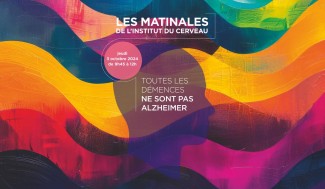
Conférence Les matinales de l'Institut du Cerveau: not all forms of dementia are Alzheimer’s

Visuel de la conférence
Retour à la recherche

This conference will allow us to discover the work of three experts from the Brain Institute, who are working to slow down, or even halt, the development of different types of dementia.

Problems with memory, behaviour, language... While these symptoms suggest Alzheimer’s disease in the elderly, other neurodegenerative diseases can cause similar disorders. This is the case, for example, of fronto-temporal dementia (FTD), which affects around 6 000 people in France.

After a clinical presentation of frontal lobe pathologies such as atypical forms of Alzheimer’s disease or FTD, our experts will present two research projects ranging from studying the behaviour of patients in real life conditions to identifying brain cell abnormalities in people with these disorders.

See you on Thursday, October 3, 2024 from 9:45 a.m. to 12:00 p.m. on our YouTube channel to follow the conference live (replay will also be available).


On the agenda

Introduction by a member of the General Directorate of the Brain Institute


The frontal lobe and its pathologies, by Prof. Richard Lévy, Director of the team “FrontLAB: Functions and dysfunctions of frontal systems” at the Brain Institute, Neurologist (AP-HP), Professor of Neurology (Sorbonne University) and Director of the Institute of Memory and Alzheimer’s Disease (IM2A).


The study of behaviors in neurodegenerative diseases in real-life conditions, by Dr. Lara Migliaccio, neurologist and Inserm researcher in the "FrontLAB: Functions and dysfunctions of frontal systems" team at the Brain Institute.


Model of human brain tissue to model fronto-temporal dementia, by Morwena Latouche, researcher in the team “Molecular bases, pathophysiology and treatment of neurodegenerative diseases” at the Institut du Cerveau and senior lecturer at the Ecole pratique des Hautes Études.

News that might interest you

Les ondes lentes de l’éveil
Sleep-like slow waves: early sentinels of Alzheimer’s disease?
What if the risk of developing Alzheimer’s disease could be assessed with an EEG? Pierre Champetier and his colleagues in the DreamTeam think the idea is worth taking seriously. In a study published in Alzheimer’s & Dementia, the team shows that slow...
09.07.2026 Research, science & health
Traitements anti-Alzheimer
Anti-Alzheimer Treatments: A Long-Term Beneficial Effect on Symptoms
There is currently no cure for Alzheimer's disease. The treatments available in France—which are not reimbursed—are known as symptomatic treatments, meaning that they act on the consequences of the disease rather than its underlying cause. In 2018...
02.18.2026 Research, science & health
À la recherche de marqueurs d’imagerie dans la démence frontotemporale
Searching for Imaging Markers in Frontotemporal Dementia
Could exploring the relationships between different brain networks help us understand frontotemporal dementia (FTD)? This neurodegenerative disease, which progresses at varying rates, is often diagnosed late—when clinical signs are already severe. At...
01.07.2025 Research, science & health
02 December 2024
Visuel of Scientific lectures
Scientific lectures: Michael GREICIUS
Speaker : Michael GREICIUS, Stanford medicine health care. "Reaching for high-hanging fruit in Alzheimer’s disease genetics"
11.12.2024 Scientific events
méninges de la souris
Mutations that cause meningiomas are widespread in healthy tissues
Sometimes, in healthy tissues, mutated cells are seen that may or may not become malignant tumours. This phenomenon has already been described in the endometrium, oesophagus and epidermis. At Paris Brain Institute, Matthieu Peyre and his colleagues...
03.15.2024 Research, science & health
Organoïde de cortex humain. Les cellules progénitrices corticales apparaissent en blanc, et les nouveaux neurones en vert. Les autres cellules sont marquées en magenta en arrière-plan.
Abnormalities in neurodevelopment could lay the foundations for Alzheimer’s disease
What if Alzheimer’s disease left its mark on the embryo? Khadijeh Shabani and her colleagues from the “Brain Development” team led by Bassem Hassan (Inserm) at Paris Brain Institute show that the amyloid precursor protein (APP) has a specific...
06.19.2023 Research, science & health
See all our news