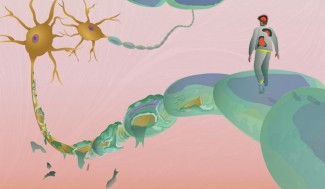

Adrien asks Céline Louapre, a neurologist and researcher at the Brain Institute, questions to better understand her mother’s disease, multiple sclerosis: what is it? Can it be treated? What can he do to help his mum on a daily basis?
Multiple Sclerosis: a disease of the central nervous system
Multiple sclerosis is an inflammatory disease that affects the central nervous system, including the brain, spinal cord in the spinal column and nerves connected to the eyes.
The central nervous system is the control centre of our body. It receives information from our environment, analyses it and sends messages to the different parts of the body to allow movement, vision, sensations or even coordination.
In multiple sclerosis, this system is disrupted by an abnormal reaction in the immune system.
Why does the immune system attack the brain?
The immune system is our body's natural defence mechanism. Its role is to protect us from viruses, bacteria and other infectious agents.
In people with multiple sclerosis, this defence system activates inappropriately and attacks the central nervous system.
This inflammation causes damage that progressively prevents neurons from functioning normally.
The Essential Role of Myelin
To understand the consequences of the disease, it is important to know the role of myelin.
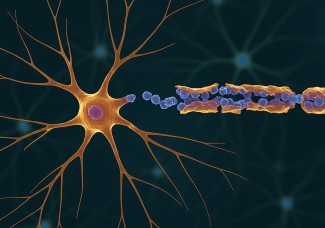
Neurons transmit information in the form of nerve signals. Myelin is a sheath that surrounds their extensions, much like a protective sheath around an electrical cable.
This sheath allows nerve messages to move quickly between the brain and the rest of the body. It also protects neurons against aggression.
In multiple sclerosis, the immune system progressively destroys this myelin sheath. The information then circulates more slowly and the neurons become more fragile. Over time, they can also be damaged, which is why some disabilities develop.
Different regions have different symptoms
The manifestations of multiple sclerosis vary from person to person. They depend mainly on the region of the nervous system affected.
When traction areas are affected, the difficulties relate to movement. Some people may need a cane to walk or have difficulty grasping objects.
In other patients, the areas involved in vision are affected, resulting in visual disturbances. The disease can also disturb sensitivity and make it more difficult to perceive contact with an object or the ground underfoot.
Beyond these symptoms, multiple sclerosis very often causes severe fatigue and difficulty concentrating, which can have a significant impact on daily life.
Can the brain repair myelin?
One of the hallmarks of the brain is its ability to make new myelin.
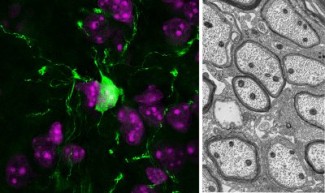
When we learn a new skill, such as playing a musical instrument or memorizing a lesson, certain brain regions naturally produce myelin to improve communication between neurons.
In multiple sclerosis, this repair mechanism also exists. In some people, myelin is effectively rebuilt after an inflammatory flare-up, which limits symptoms.
However, this restorative capacity varies greatly from one individual to another. In some patients, it is insufficient to compensate for the damage caused by the disease.
What treatments for multiple sclerosis?
Advances in research have profoundly changed the management of multiple sclerosis.
Today, there are several treatments that act directly on the immune system to limit attacks on the central nervous system.
The goal is to reduce the damage caused by inflammation and slow the progress of the disease.
Experts also stress the importance of early diagnosis. The sooner treatment is initiated, the greater the likelihood of limiting long-term consequences.
Despite these advances, some forms of the disease are still insufficiently responsive to available treatments. That is why researchers are continuing their work to better understand the mechanisms of multiple sclerosis and to develop new therapeutic approaches.
Is Multiple Sclerosis Hereditary?
This is a common question among children with an affected parent.
In the vast majority of cases, the answer is reassuring: multiple sclerosis is not usually a disease transmitted from parents to children. Although there are rare exceptions, children of an infected person will generally not develop the disease.
This information addresses a common concern of families and serves as a reminder that multiple sclerosis is not transmitted like some genetic diseases.
How to accompany a person with the disease?
Living with multiple sclerosis does not mean giving up your family or social life.
Fatigue is one of the most common symptoms of the disease. Taking breaks during the day often helps you manage your energy better. Sleeping more, however, is not always enough to overcome fatigue.
Those around them play an essential role. Continuing to share daily activities, maintaining family ties and avoiding exclusion on the basis of disability are valuable.
Talking about multiple sclerosis around the world also helps to raise awareness of the disease and to challenge conventional wisdom. With advances in research and a better understanding of its mechanisms, new therapeutic opportunities continue to emerge to improve patients’ quality of life.
Multiple Sclerosis (MS)
Multiple sclerosis (MS) is the second leading cause of acquired disability in young adults, after injury. It affects 130,000 people in France today, with 5,000 new cases diagnosed each year. This makes it a major public health issue, since it also...
Read more